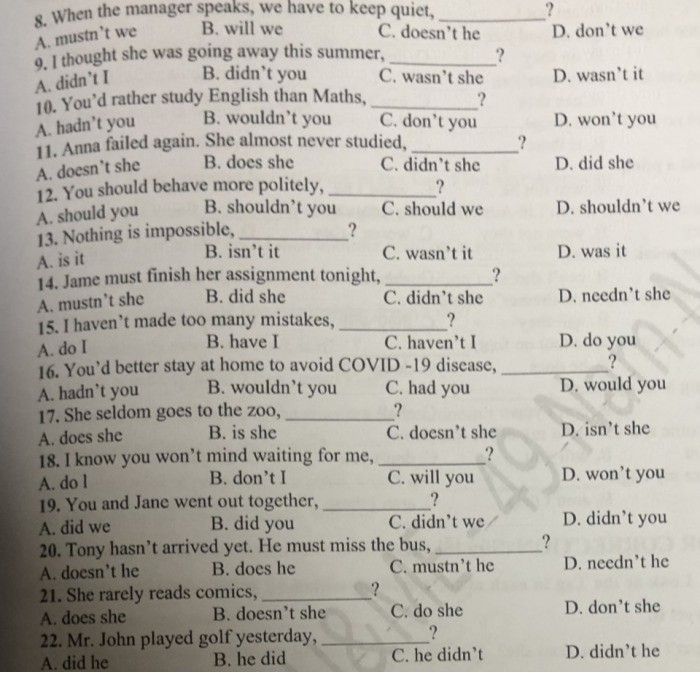
D. don't we (The main clause uses "have to," which is equivalent to "must" and takes "do/does/did" in tag questions.)
A. didn't I (The main clause is "I thought," so the tag question refers back to the subject "I.")
B. wouldn't you ("You'd rather" is a shortened form of "You would rather," so the tag uses "would.")
D. did she (The main clause is negative ("almost never"), so the tag is positive. The verb is "studied," so we use "did.")
B. shouldn't you (The main clause is positive, using "should," so the tag is negative.)
A. is it (The main clause is negative ("Nothing"), so the tag is positive. "Nothing" takes the singular pronoun "it.")
A. mustn't she ("Must" in the sense of obligation uses "mustn't" in the tag question.)
B. have I (The main clause is negative ("haven't"), so the tag is positive.)
A. hadn't you ("You'd better" is short for "You had better," so the tag uses "had.")
A. does she ("Seldom" has a negative meaning, so the tag is positive. "Goes" becomes "does.")
C. will you (The main clause is "I know you won't mind," but the tag question refers to the embedded clause "you won't mind waiting," making the tag "will you.")
D. didn't you (The subject is "You and Jane," which is equivalent to "you" (plural). The main clause is positive, so the tag is negative.)
A. doesn't he ("Must" expressing deduction or assumption uses "doesn't/don't/didn't" in the tag question.)
B. does she ("Rarely" has a negative meaning, so the tag is positive. "Reads" becomes "does.")
C. didn't he (The main clause is positive, so the tag is negative. "Played" becomes "didn't.")





 AI Chat





 Xem thêm


 Thưởng th.04.2026
 Bảng xếp hạng