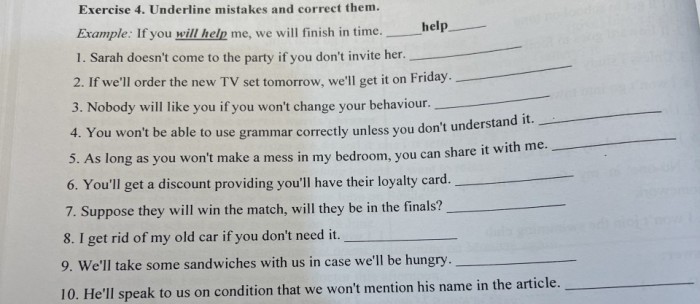
Sarah doesn't come to the party if you don't invite her. -> won't come
Explanation: This is a Type 1 conditional (real possibility). We need "will" in the main clause.
If we'll order the new TV set tomorrow, we'll get it on Friday. -> order
Explanation: In Type 1 conditionals, the "if" clause uses the present simple, not "will."
Nobody will like you if you won't change your behavior. -> don't change
Explanation: Again, Type 1 conditional – use present simple in the "if" clause.
You won't be able to use grammar correctly unless you don't understand it. -> understand
Explanation: "Unless" already carries a negative meaning, so we don't need "don't."
As long as you won't make a mess in my bedroom, you can share it with me. -> don't make
Explanation: "As long as" introduces a condition. Use present simple in the condition clause.
You'll get a discount providing you'll have their loyalty card. -> provided you have / providing you have
Explanation: "Provided that" or "providing" introduces a condition. Use present simple, not "will."
Suppose they will win the match, will they be in the finals? -> win
Explanation: "Suppose" is similar to "if" here. Use present simple in the conditional clause.
I get rid of my old car if you don't need it. -> 'll get rid / will get rid
Explanation: This is a Type 1 conditional. We need "will" in the main clause to indicate future action.
We'll take some sandwiches with us in case we'll be hungry. -> we're
Explanation: "In case" suggests a possible future situation. Use present simple, not "will."
He'll speak to us on condition that we won't mention his name in the article. -> don't mention
Explanation: "On condition that" introduces a condition. Use present simple, not "will."





 AI Chat





 Xem thêm


 Thưởng th.04.2026
 Bảng xếp hạng