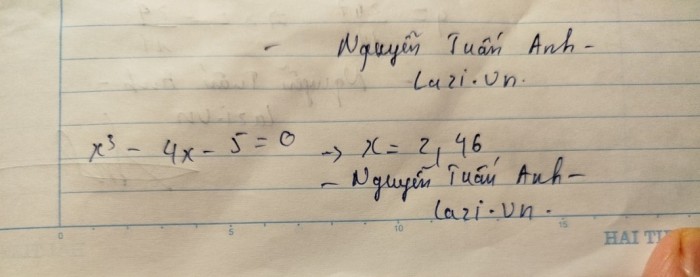
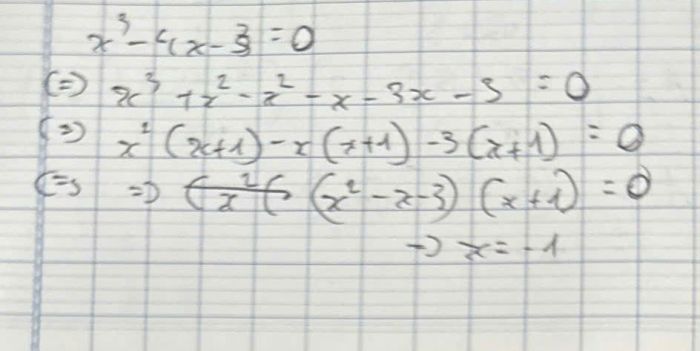
Tham khảo câu trả lời từ Trợ lý ảo Lazi To solve the equation \( x^3 - 4x - 5 = 0 \), you can try several methods, like graphing, numerical methods, or finding rational roots. ### Numerical Solution: 1. **Graphing Method**: You can graph the function \( f(x) = x^3 - 4x - 5 \) and look for where the graph intersects the x-axis. This point of intersection is the real root of the equation. 2. **Newton's Method**: This is an iterative numerical method to approximate the root: - Choose an initial guess \( x_0 \). A good first guess might be around \( x = 2 \) (since \( f(2) = 2^3 - 4 \times 2 - 5 = -5 \) which is negative, and \( f(3) = 3^3 - 4 \times 3 - 5 = 4 \) which is positive, indicating a root between 2 and 3). - Use the formula: \( x_{n+1} = x_n - \frac{f(x_n)}{f'(x_n)} \). - Here, \( f(x) = x^3 - 4x - 5 \) and \( f'(x) = 3x^2 - 4 \). - Iterate until you achieve the desired precision. ### Finding Rational Roots: You can also check for rational solutions using the Rational Root Theorem, which suggests that possible rational roots are factors of the constant term (-5) divided by factors of the leading coefficient (1). Thus, possible rational roots are \( \pm1, \pm5 \). Checking these: - \( f(1) = 1^3 - 4 \times 1 - 5 = -8 \) - \( f(-1) = (-1)^3 - 4 \times (-1) - 5 = 0 \) We find that \( x = -1 \) is indeed a root. ### Simplifying the Polynomial: Since \( x = -1 \) is a root, you can perform polynomial division to factor out \( (x + 1) \) from \( x^3 - 4x - 5 \). This gives: \[ (x^3 - 4x - 5) \div (x + 1) = x^2 - x - 5 \] Now you have \( (x + 1)(x^2 - x - 5) = 0 \). ### Solving the Quadratic: To find the roots of \( x^2 - x - 5 = 0 \), use the quadratic formula: \[ x = \frac{-b \pm \sqrt{b^2 - 4ac}}{2a} \] where \( a = 1 \), \( b = -1 \), \( c = -5 \). \[ x = \frac{-(-1) \pm \sqrt{(-1)^2 - 4 \times 1 \times (-5)}}{2 \times 1} \] \[ x = \frac{1 \pm \sqrt{1 + 20}}{2} \] \[ x = \frac{1 \pm \sqrt{21}}{2} \] ### Solutions: The solutions to the original equation \( x^3 - 4x - 5 = 0 \) are: 1. \( x = -1 \) 2. \( x = \frac{1 + \sqrt{21}}{2} \) 3. \( x = \frac{1 - \sqrt{21}}{2} \)