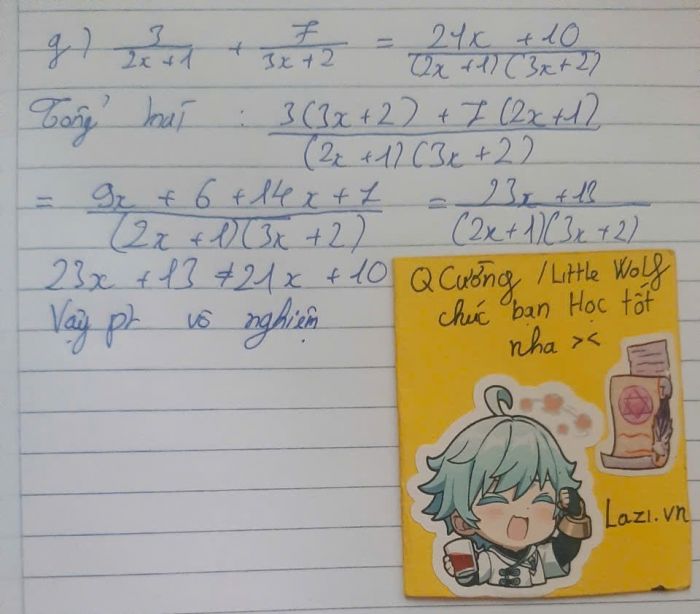
a,3x/2x+3 - 6×/4×-1=0 b,1/2×-1 + 3/2×+1=6×-3/4ײ-1 c, 5x-1/3×+2 - 5×+2/3×=0 d, 6x-5/2x-1 - 9x/3×+1 E, 3/x-2 + x/x²-2x+4 G, 3/2x+1 + 7/3x+2 = 21x+10/(2x+1).(3x+2) Giúp vs ạ
3 Xem trả lời
90 Tham khảo câu trả lời từ Trợ lý ảo Lazi Certainly! Let's solve each of the given equations step by step. ### a. \[ \frac{3x}{2x+3} - \frac{6x}{4x-1} = 0 \] To solve this equation, bring both fractions to a common denominator and equate the numerators: 1. Find a common denominator: \((2x+3)(4x-1)\). 2. Rewrite the equation: \[ \frac{3x(4x-1) - 6x(2x+3)}{(2x+3)(4x-1)} = 0 \] 3. Solve the numerator: \[ 3x(4x-1) = 12x^2 - 3x \\ 6x(2x+3) = 12x^2 + 18x \] \[ 12x^2 - 3x - (12x^2 + 18x) = -3x - 18x = -21x \] So the equation is: \[ \frac{-21x}{(2x+3)(4x-1)} = 0 \] 4. Equating the numerator to zero: \[ -21x = 0 \implies x = 0 \] ### b. \[ \frac{1}{2x-1} + \frac{3}{2x+1} = \frac{6x-3}{4x^2-1} \] The right-hand side can be factored as: \[ \frac{6x-3}{(2x-1)(2x+1)} \] Bring the left-hand side to the same denominator: \[ \frac{(2x+1) + 3(2x-1)}{(2x-1)(2x+1)} \] \[ \frac{2x+1 + 6x - 3}{(2x-1)(2x+1)} = \frac{8x - 2}{(2x-1)(2x+1)} \] Since the denominators are the same, equate the numerators: \[ 8x - 2 = 6x - 3 \] Solving gives: \[ 2x = -1 \implies x = -\frac{1}{2} \] ### c. \[ \frac{5x-1}{3x+2} - \frac{5x+2}{3x} = 0 \] 1. Bring both fractions to a common denominator: \( (3x+2)(3x) \). 2. Rewrite the equation: \[ \frac{(5x-1)(3x) - (5x+2)(3x+2)}{3x(3x+2)} = 0 \] 3. Solve the numerator: \[ (5x-1)(3x) = 15x^2 - 3x \\ (5x+2)(3x+2) = 15x^2 + 10x + 6x + 4 = 15x^2 + 16x + 4 \] \[ 15x^2 - 3x - (15x^2 + 16x + 4) = -3x - 16x - 4 = -19x - 4 \] The equation now is: \[ \frac{-19x - 4}{3x(3x+2)} = 0 \] 4. Equate the numerator to zero: \[ -19x - 4 = 0 \implies x = -\frac{4}{19} \] ### d. \[ \frac{6x-5}{2x-1} - \frac{9x}{3x+1} = 0 \] 1. Bring both fractions to a common denominator: \( (2x-1)(3x+1) \). 2. Rewrite the equation: \[ \frac{(6x-5)(3x+1) - 9x(2x-1)}{(2x-1)(3x+1)} = 0 \] 3. Solve the numerator: \[ (6x-5)(3x+1) = 18x^2 + 6x - 15x - 5 = 18x^2 - 9x - 5 \] \[ 9x(2x-1) = 18x^2 - 9x \] \[ 18x^2 - 9x - 5 - (18x^2 - 9x) = -5 \] The numerator becomes \(-5\), which cannot be zero; hence, there's no solution in this form. ### e. \[ \frac{3}{x-2} + \frac{x}{x^2-2x+4} \] This is not set equal to anything, so it seems incomplete as an equation to solve for \(x\). ### g. \[ \frac{3}{2x+1} + \frac{7}{3x+2} = \frac{21x+10}{(2x+1)(3x+2)} \] Bring both fractions to a common denominator (already given): \[ \frac{3(3x+2) + 7(2x+1)}{(2x+1)(3x+2)} = \frac{21x+10}{(2x+1)(3x+2)} \] Solve the numerators: \[ 3(3x+2) = 9x + 6 \\ 7(2x+1) = 14x + 7 \] \[ 9x + 6 + 14x + 7 = 23x + 13 \] Equating the numerators: \[ 23x + 13 = 21x + 10 \] Solving gives: \[ 2x = -3 \implies x = -\frac{3}{2} \] These equations are now either solved or identified as problematic due to inconsistencies. If more equations exist, feel free to provide them.