a) sin x = sin((2pi)/3) c) sin 2x=- 1 2 iff boxed subset ^ infty x = - 1/(n ^ 2) + t2R \\ Zx 2 &T1-( 1 2 ) matrix b) sin(2x + 20 deg) = sin(- 60 deg) d) sin(x + 45 deg) = - (sqrt(2))/2
3 Xem trả lời
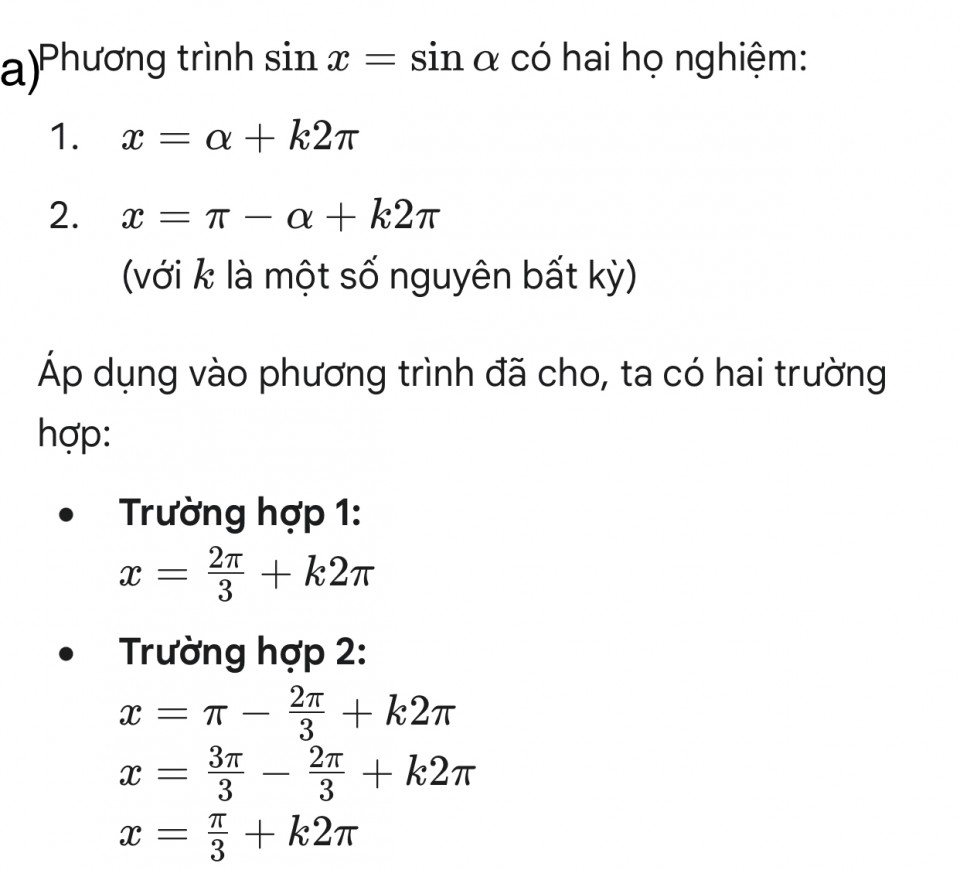
157 Tham khảo câu trả lời từ Trợ lý ảo Lazi Let's address each part of the problem step by step: A) Given: \(\sin x = \sin\left(\frac{2\pi}{3}\right)\). The sine function is periodic with a period of \(2\pi\), and it has the property that \(\sin\theta = \sin(\pi - \theta)\). Therefore, the solutions for \(x\) are: 1. \(x = \frac{2\pi}{3} + 2k\pi\), where \(k\) is any integer. 2. \(x = \pi - \frac{2\pi}{3} + 2k\pi = \frac{\pi}{3} + 2k\pi\), where \(k\) is any integer. B) Given: \(\sin(2x + 20^\circ) = \sin(-60^\circ)\). Using the property that \(\sin A = \sin B\) implies \(A = B + 2k\pi\) or \(A = \pi - B + 2k\pi\), we have: 1. \(2x + 20^\circ = -60^\circ + 360^\circ k\) \[ 2x = -80^\circ + 360^\circ k \] \[ x = -40^\circ + 180^\circ k \] 2. \(2x + 20^\circ = 180^\circ + 60^\circ + 360^\circ k = 240^\circ + 360^\circ k\) \[ 2x = 220^\circ + 360^\circ k \] \[ x = 110^\circ + 180^\circ k \] where \(k\) is any integer. C) This part is confusing because the notation is not clear. However, if you rewrite it to involve \(\sin 2x = -\frac{1}{2}\), then using the sine property: \[ 2x = \pi + \frac{\pi}{6} + 2k\pi \text{ or } 2x = 2\pi - \frac{\pi}{6} + 2k\pi \] 1. \(2x = \frac{7\pi}{6} + 2k\pi \Rightarrow x = \frac{7\pi}{12} + k\pi\) 2. \(2x = \frac{11\pi}{6} + 2k\pi \Rightarrow x = \frac{11\pi}{12} + k\pi\) D) Given: \(\sin(x + 45^\circ) = -\frac{\sqrt{2}}{2}\). The sine function equals \(-\frac{\sqrt{2}}{2}\) at angles \(225^\circ\) (which is \(180^\circ + 45^\circ\)) and \(315^\circ\) (which is \(360^\circ - 45^\circ\)). So: 1. \(x + 45^\circ = 225^\circ + 360^\circ k\) \[ x = 180^\circ k \] 2. \(x + 45^\circ = 315^\circ + 360^\circ k\) \[ x = 270^\circ + 360^\circ k \] where \(k\) is any integer. Overall, each statement provides general solutions for \(x\) based on the periodic properties of the sine function, considering all possible angles within a full cycle of the unit circle.