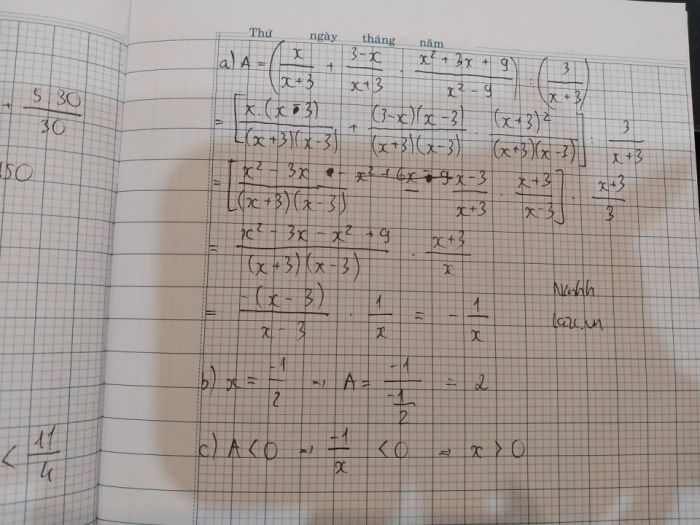
----- Nội dung ảnh ----- 4. Cho biểu thức A= \(\left( \frac{x}{x+3} + \frac{3-x}{x+3} \cdot \frac{x^2+3x+9}{x^2-9} \right) : \frac{3}{x+3}\). a) Rút gọn biểu thức A. b) Tìm giá trị của A tại \(x = -\frac{1}{2}\). c) Tìm giá trị của \(x\) để \(A < 0\).
7 Xem trả lời
132 Tham khảo câu trả lời từ Trợ lý ảo Lazi To solve the given expression \( A \) and its parts, we can go through the following steps: ### a) Rút gọn biểu thức A. Given: \[ A = \left( \frac{x}{x+3} + \frac{3-x}{x+3} \cdot \frac{x^2+3x+9}{x^2-9} \right) : \frac{3}{x+3} \] #### Step 1: Simplify the expression inside the parenthesis: Combine the terms within the parenthesis (use a common denominator): \[ \frac{x + (3-x)}{x+3} = \frac{3}{x+3} \] So the expression becomes: \[ A = \left( \frac{3}{x+3} \cdot \frac{x^2+3x+9}{x^2-9} \right) : \frac{3}{x+3} \] #### Step 2: Simplify the division: Dividing by a fraction is the same as multiplying by its reciprocal: \[ A = \frac{3}{x+3} \cdot \frac{x^2+3x+9}{x^2-9} \cdot \frac{x+3}{3} \] Cancel out the common terms: \[ A = \frac{x^2+3x+9}{x^2-9} \] #### Step 3: Simplify the fraction: Notice \(x^2 - 9 = (x - 3)(x + 3)\): \[ A = \frac{x^2+3x+9}{(x-3)(x+3)} \] ### b) Tìm giá trị của A tại \( x = -\frac{1}{2} \). Substitute \( x = -\frac{1}{2} \) into the simplified expression of \( A \): \[ A = \frac{\left(-\frac{1}{2}\right)^2 + 3\left(-\frac{1}{2}\right) + 9}{\left(-\frac{1}{2} - 3\right)\left(-\frac{1}{2} + 3\right)} \] Calculate each part: \[ = \frac{\frac{1}{4} - \frac{3}{2} + 9}{\left(-\frac{7}{2}\right)\left(\frac{5}{2}\right)} \] Simplify: \[ = \frac{\frac{37}{4}}{\left(-\frac{35}{4}\right)} = -\frac{37}{35} \] ### c) Tìm giá trị của \( x \) để \( A < 0 \). We know: \[ A = \frac{x^2+3x+9}{(x-3)(x+3)} \] For \( A \) to be negative: 1. The numerator and denominator have opposite signs. Determine the sign of the denominator: - Denominator \( = (x-3)(x+3) \). Determine intervals: - \( (x-3)(x+3) > 0 \) for \( x < -3 \) or \( x > 3 \). - \( (x-3)(x+3) < 0 \) for \( -3 < x < 3 \). Determine the sign of the numerator: - Quadratic \( x^2 + 3x + 9 \) is always positive since it does not cross the x-axis (discriminant \( b^2-4ac = -27 \) is negative). So \( A < 0 \) when \( (x-3)(x+3) < 0 \), i.e., for \( -3 < x < 3 \). Thus, for \( A < 0 \), \( x \) must satisfy \( -3 < x < 3 \).