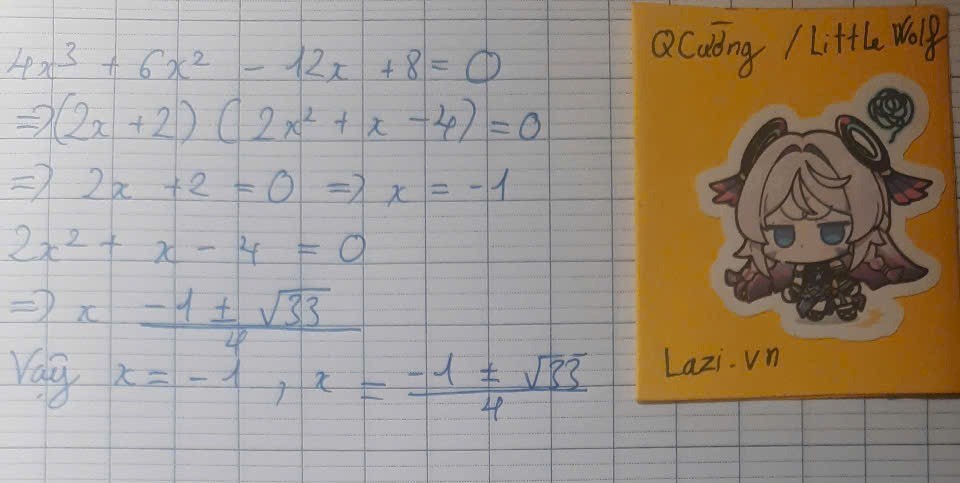
Tham khảo câu trả lời từ Trợ lý ảo Lazi To solve the polynomial equation \(4x^3 + 6x^2 - 12x + 8 = 0\), we can try to find rational roots using the Rational Root Theorem, which states that any rational solution, in the form of a fraction \(\frac{p}{q}\), will have \(p\) as a factor of the constant term and \(q\) as a factor of the leading coefficient. For this equation, the constant term is \(8\) and the leading coefficient is \(4\). The factors of \(8\) are \(\pm 1, \pm 2, \pm 4, \pm 8\), and the factors of \(4\) are \(\pm 1, \pm 2, \pm 4\). Therefore, the possible rational roots are \(\pm 1, \pm 2, \pm 4, \pm 8, \pm \frac{1}{2}, \pm \frac{1}{4}\). Now, let's test these values to see if they are roots of the equation: - Testing \(x = 1\): \[ 4(1)^3 + 6(1)^2 - 12(1) + 8 = 4 + 6 - 12 + 8 = 6 \neq 0 \] - Testing \(x = -1\): \[ 4(-1)^3 + 6(-1)^2 - 12(-1) + 8 = -4 + 6 + 12 + 8 = 22 \neq 0 \] - Testing \(x = 2\): \[ 4(2)^3 + 6(2)^2 - 12(2) + 8 = 32 + 24 - 24 + 8 = 40 \neq 0 \] - Testing \(x = -2\): \[ 4(-2)^3 + 6(-2)^2 - 12(-2) + 8 = -32 + 24 + 24 + 8 = 24 \neq 0 \] - Testing \(x = 4\): \[ 4(4)^3 + 6(4)^2 - 12(4) + 8 = 256 + 96 - 48 + 8 = 312 \neq 0 \] - Testing \(x = -4\): \[ 4(-4)^3 + 6(-4)^2 - 12(-4) + 8 = -256 + 96 + 48 + 8 = -104 \neq 0 \] - Testing \(x = \frac{1}{2}\): \[ 4\left(\frac{1}{2}\right)^3 + 6\left(\frac{1}{2}\right)^2 - 12\left(\frac{1}{2}\right) + 8 = \frac{1}{2} + \frac{3}{2} - 6 + 8 = \frac{1}{2} + \frac{3}{2} - 6 + 8 = \frac{9}{2} - \frac{12}{2} + \frac{16}{2} = \frac{13}{2} \neq 0 \] - Testing \(x = -\frac{1}{2}\): \[ 4\left(-\frac{1}{2}\right)^3 + 6\left(-\frac{1}{2}\right)^2 - 12\left(-\frac{1}{2}\right) + 8 = -\frac{1}{2} + \frac{3}{2} + 6 + 8 = \frac{0}{2} + \frac{12}{2} + \frac{16}{2} = \frac{28}{2} = 14 \neq 0 \] Since none of the tested values are roots, it suggests that the polynomial may not have rational roots. Therefore, more advanced techniques like the use of numerical solutions or factoring by other means may be necessary. Alternatively, you can also use graphing or numerical solvers to approximate the real roots of the polynomial. In summary, without rational roots, you might consider numerical methods or tools to solve this cubic equation, or attempting synthetic division if there's information on possible actual roots.