x^3-16x=0 x^2+3x-10=0 3x^2+5x+2=0 (x-1)^2+x(4-x)=11 (x-5)^2-x.(x+2)=5 x(x+4)-x^2-6x=10 6x^2-(2x-3)(3x+2)=1 (x+2)(x-5)+x(1-x)=2 (x-1)(2-x)+(x-3)^2=4-2x
6 Xem trả lời
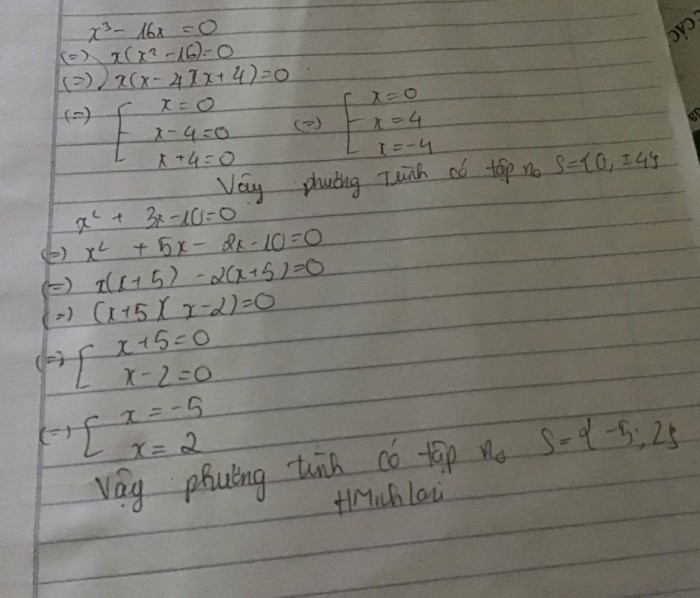
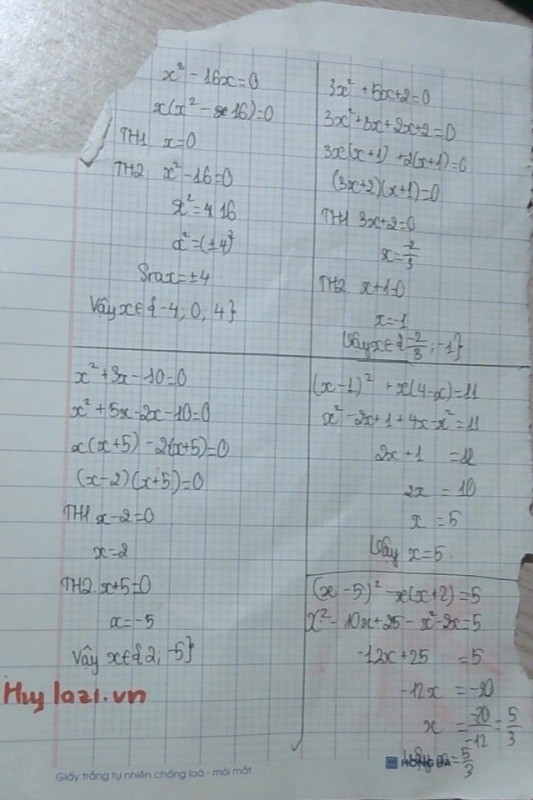
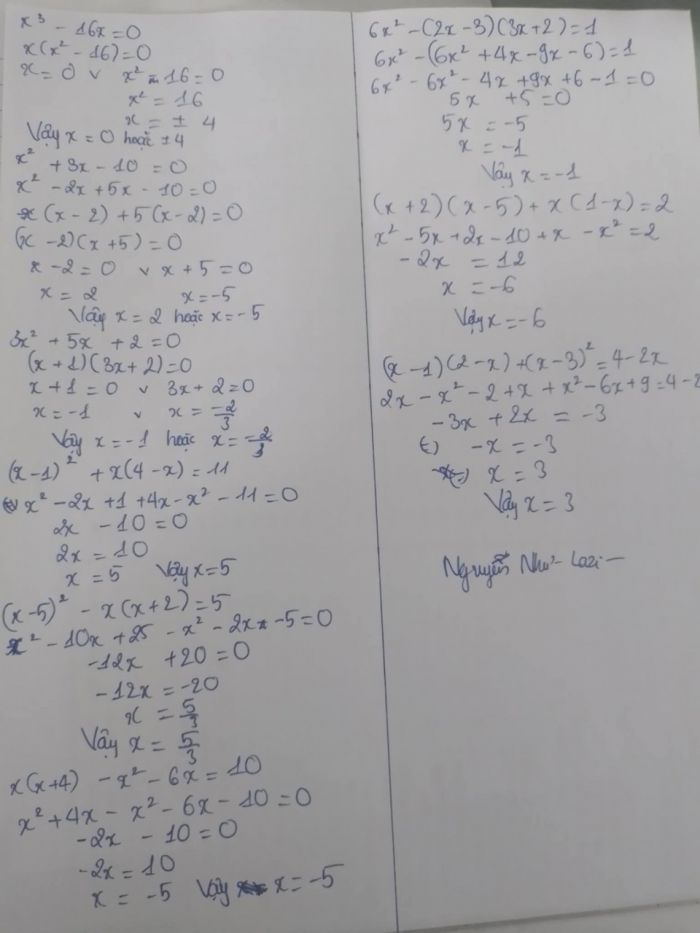
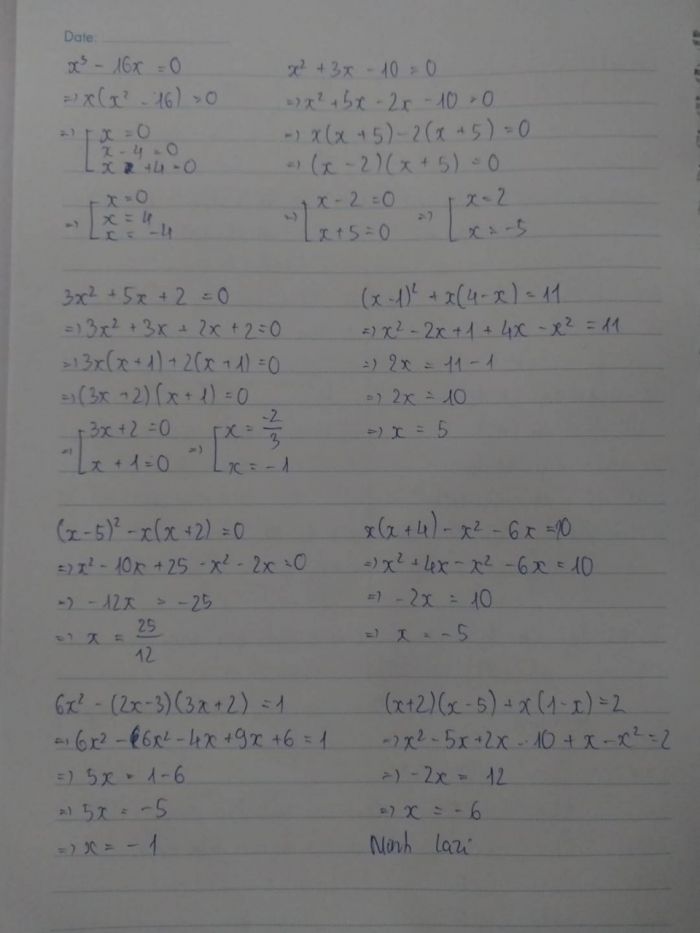
108 Tham khảo câu trả lời từ Trợ lý ảo Lazi Let's solve each equation step by step. 1. Solve \[x^3 - 16x = 0\] Factor the equation as follows: \[ x(x^2 - 16) = 0 \] This gives us two factors: \[ x = 0 \quad \text{or} \quad x^2 - 16 = 0 \] Solve \(x^2 - 16 = 0\): \[ x^2 = 16 \implies x = \pm 4 \] Therefore, the solutions are \(x = 0\), \(x = 4\), and \(x = -4\). 2. Solve \[x^2 + 3x - 10 = 0\] Use the quadratic formula: \(x = \frac{{-b \pm \sqrt{{b^2 - 4ac}}}}{2a}\), where \(a=1\), \(b=3\), and \(c=-10\). \[ x = \frac{{-3 \pm \sqrt{{3^2 - 4 \times 1 \times (-10)}}}}{2 \times 1} = \frac{{-3 \pm \sqrt}}{2} \] \[ x = \frac{{-3 \pm \sqrt{49}}}{2} = \frac{{-3 \pm 7}}{2} \] \[ x = 2 \quad \text{or} \quad x = -5 \] 3. Solve \[3x^2 + 5x + 2 = 0\] Apply the quadratic formula: \[ x = \frac{{-5 \pm \sqrt{{5^2 - 4 \times 3 \times 2}}}}{2 \times 3} \] \[ x = \frac{{-5 \pm \sqrt}}{6} = \frac{{-5 \pm 1}}{6} \] \[ x = -\frac{4}{6} = -\frac{2}{3} \quad \text{or} \quad x = -1 \] 4. Solve \((x-1)^2 + x(4-x) = 11\) Expand and simplify: \[ (x-1)^2 = x^2 - 2x + 1 \] \[ x(4-x) = 4x - x^2 \] Combine both and set equal to 11: \[ x^2 - 2x + 1 + 4x - x^2 = 11 \] \[ 2x + 1 = 11 \implies 2x = 10 \implies x = 5 \] 5. Solve \((x-5)^2 - x(x+2) = 5\) Expand and simplify: \[ (x-5)^2 = x^2 - 10x + 25 \] \[ x(x+2) = x^2 + 2x \] Set the equations together: \[ x^2 - 10x + 25 - x^2 - 2x = 5 \] \[ -12x + 25 = 5 \implies -12x = -20 \implies x = \frac{5}{3} \] 6. Solve \(x(x+4) - x^2 - 6x = 10\) Expand and simplify: \[ x^2 + 4x - x^2 - 6x = 10 \] \[ -2x = 10 \implies x = -5 \] 7. Solve \(6x^2 - (2x-3)(3x+2) = 1\) Expand the term: \[ (2x-3)(3x+2) = 6x^2 + 4x - 9x - 6 = 6x^2 - 5x - 6 \] Substitute back: \[ 6x^2 - (6x^2 - 5x - 6) = 1 \] \[ 5x + 6 = 1 \implies 5x = -5 \implies x = -1 \] 8. Solve \((x+2)(x-5) + x(1-x) = 2\) Expand and simplify: \[ (x+2)(x-5) = x^2 - 5x + 2x - 10 = x^2 - 3x - 10 \] \[ x(1-x) = x - x^2 \] Substitute into the equation: \[ x^2 - 3x - 10 + x - x^2 = 2 \] \[ -2x - 10 = 2 \implies -2x = 12 \implies x = -6 \] 9. Solve \((x-1)(2-x) + (x-3)^2 = 4-2x\) Expand and simplify: \[ (x-1)(2-x) = 2x - x^2 - 2 + x = -x^2 + 3x - 2 \] \[ (x-3)^2 = x^2 - 6x + 9 \] Substitute into the equation: \[ -x^2 + 3x - 2 + x^2 - 6x + 9 = 4 - 2x \] \[ -3x + 7 = 4 - 2x \implies -x = -3 \implies x = 3 \]