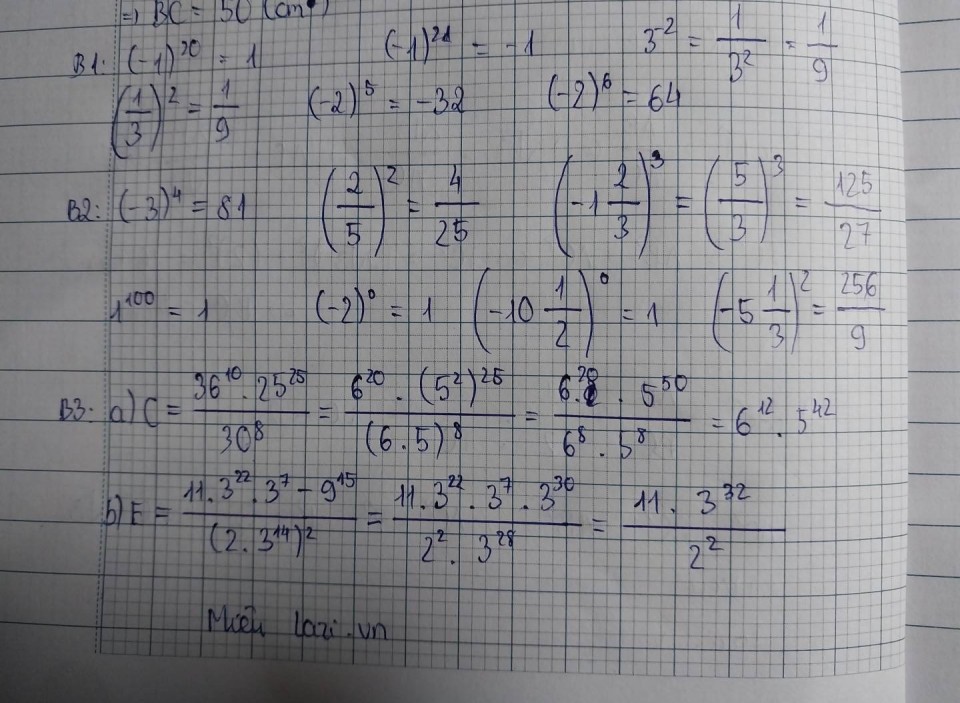
----- Nội dung ảnh ----- Bài 1: Tính \((-1)^{20}-(1)^{1/3}^{2} \left( \frac{1}{3} \right)^{2} - (2)^{5} - (2)^{6}\) Bài 2: Tính \((-3)^{*} \left( \frac{2}{5} \right)^{2} \left( \frac{1}{3} \right)^{3} \cdot 1^{00} \cdot (-2)^{0}\) c) \(\left( -10 \frac{1}{2} \right)^{0}\) :: d) \(\left( -5 \frac{1}{3} \right)^{3}\) Bài 3: a) \(C = \frac{36^{10} \cdot 25^{15}}{30^{8}}\) b) \(E = \frac{11 \cdot 3^{2} \cdot 7^{-9} \cdot 15}{\left( 2^{3} \cdot 14^{2} \right)^{2}}\) Bài 4: Chứng minh rằng: \(2015^{2015} - 1\) chia hết cho \(2014\). Bài 5: Tính \(C = 2^{2} + 4^{2} + 6^{2} + \ldots + 20^{2}\)
2 Xem trả lời
69 Tham khảo câu trả lời từ Trợ lý ảo Lazi Let's go through each of these problems step by step. ### Bài 1: - The expression involves powers and products of negative numbers, this leads to a sign determination. Without specific values for \( n \), we can't simplify further, but the expression can be evaluated given \( n \). ### Bài 2: - Similar approach as in bài 1 with rational powers. ### Bài 3: a) Solve: \[ C = \frac{36^{10} \times 25^{15}}{30^8} \] 1. Simplify the bases: - \( 36 = 6^2 \) - \( 25 = 5^2 \) - \( 30 = 2 \times 3 \times 5 \) 2. Substitute back: \[ C = \frac{(6^2)^{10} \times (5^2)^{15}}{(2 \times 3 \times 5)^8} \] \[ = \frac{6^{20} \times 5^{30}}{2^8 \times 3^8 \times 5^8} \] 3. Simplify: \[ = \frac{6^{20}}{2^8 \times 3^8} \times 5^{22} \] b) Solve: \[ E = \frac{11 \times 3^2 \times 3^7 - 9^{15}}{(2 \times 3^{14})^2} \] 1. Simplify numerator: - Combine \( 3^2 \) and \( 3^7 \) to get \( 3^9 \) 2. Numerator simplifies to: \[ E_{\text{num}} = 11 \times 3^9 - 9^{15} \] 3. Simplify denominator: - \( = (2^2 \times 3^{28}) \) 4. Simplify further using basic arithmetic operations. ### Bài 4: Prove: \( 2015^{2015} - 1 \) is divisible by \( 2014 \). Use Fermat's Little Theorem or modular arithmetic to show the divisibility. ### Bài 5: Calculate: \( C = 2^2 + 4^2 + 6^2 + \ldots + 20^2 \) Recognize the series can be simplified: - It is an arithmetic sequence. - Use the formula to compute sum of squares: \[ S = \sum_{k=1}^{n} (2k)^2 = 4 \sum_{k=1}^{n} k^2 \] Where \( n = 10 \). Calculate by plugging into the formula: \[ \sum_{k=1}^{n} k^2 = \frac{n(n+1)(2n+1)}{6} \] Plug values to find sum.