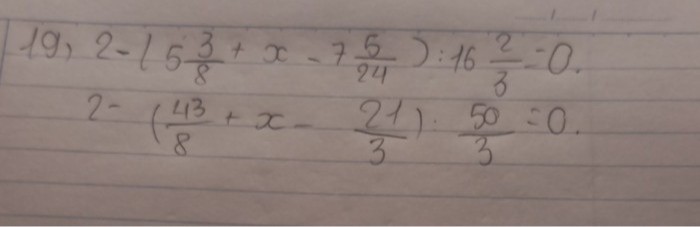
----- Nội dung dịch tự động từ ảnh ----- 19, 2 - 1 \(\frac{5\sqrt{3}}{8}\) + x - \(\frac{7}{24}\) : \(\frac{16}{3}\) - 0. 2 - \(\left(\frac{4\sqrt{3}}{8} + x - \frac{21}{3}\right) : \frac{50}{3}\) = 0.
0 Xem trả lời
110 Tham khảo câu trả lời từ Trợ lý ảo Lazi To compute the given mathematical expressions, let's break them down step by step. 1. For the first expression: \[ 2 - \left( \frac{5}{8} + x - \frac{7}{24} \right) \cdot \frac{16}{3} = 0 \] Simplifying inside the parentheses: - Convert \(\frac{5}{8}\) and \(\frac{7}{24}\) to a common denominator (which is 24): \[ \frac{5}{8} = \frac{15}{24} \] - Now, combining: \[ \frac{15}{24} - \frac{7}{24} = \frac{15 - 7}{24} = \frac{8}{24} = \frac{1}{3} \] - Therefore, the new equation becomes: \[ 2 - \left(\frac{1}{3} + x\right) \cdot \frac{16}{3} = 0 \] 2. For the second expression: \[ 2 - \left( \frac{4}{3} + x - \frac{21}{3} \right) \cdot \frac{50}{3} = 0 \] Simplifying inside the parentheses: \[ \frac{4}{3} - \frac{21}{3} = \frac{4 - 21}{3} = \frac{-17}{3} \] - The equation becomes: \[ 2 - \left(-\frac{17}{3} + x\right) \cdot \frac{50}{3} = 0 \] Now, calculate \(x\) in both cases and isolate it. For more precise calculations or detailed solutions, let me know if you want to see a specific part worked out!